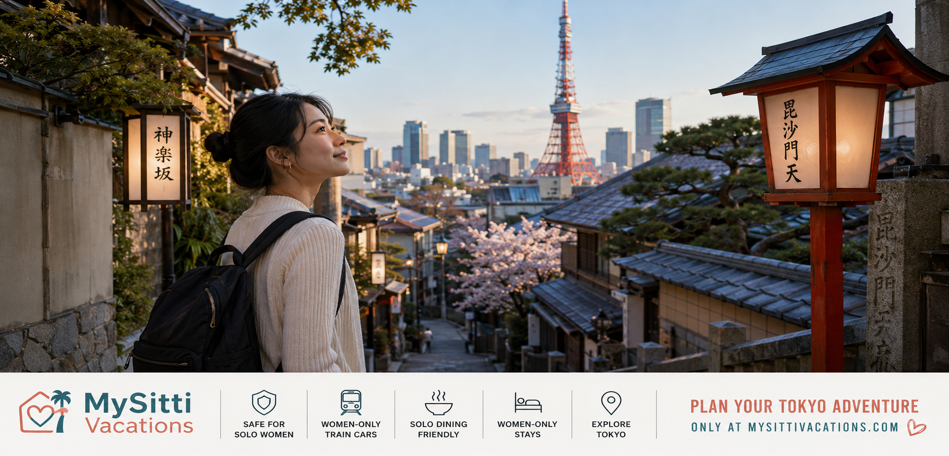
Tokyo is widely regarded as the gold standard for solo female travel. For the Millennial or Gen X woman, it offers a rare combination of ultra-modern convenience and deeply meditative tradition. Whether you’re a digital nomad seeking a high-tech “pod” in Akihabara or a creative spirit exploring the quiet alleys of Kagurazaka, Tokyo provides a secure, friction-free environment. Here, dining alone is a respected art form and safety functions as public infrastructure.
Why Tokyo is Perfect for Solo Female Millennial Travelers
Tokyo is a premier destination for solo women. First, the city features widespread “Women-Only” infrastructure. This includes dedicated subway cars and hotel floors. Second, the city maintains an extremely low violent crime rate. The neighborhood kōban (police box) system ensures help is always within a single block. Meanwhile, the local Ohitorisama (solo culture) makes independent dining socially seamless and deeply welcoming.
Top 5 Must-Do Experiences for Solo Women
Solo exploration in Tokyo allows for a deep, sensory immersion that groups often lose. These five experiences prioritize personal safety while offering high-value cultural engagement.
1. Boutique “Sento” Rejuvenation in Kagurazaka
Avoid the tourist-heavy onsens. Instead, head to a local sento (public bath) in Kagurazaka, which is often called the “Little Paris” of Tokyo. These facilities are strictly gender-segregated. Therefore, they provide a safe, communal space to experience Japanese wellness. Afterward, wander the cobbled backstreets to find hidden French-Japanese fusion cafes that are perfect for a solo afternoon read.
2. High-Tech Solitude at a Women-Only Capsule Hotel
For a uniquely Japanese experience, book a night at the Akihabara Bay Hotel. This facility is exclusively for women. It features high-security keycard access, pristine aesthetic pods, and cozy communal lounges. Consequently, it offers an affordable, hyper-safe way to experience the neon heart of the city without the chaos of a traditional hostel.
3. Morning Zen at the Nezu Museum Garden
Located in Aoyama, this museum is a masterclass in architecture. However, the true solo gem is its hidden garden. It functions as a perfect “pause button” in the city where you can walk gravel paths and sit by ancient stone lanterns. Because it is rarely crowded, it provides a safe and tranquil space for reflection away from the busy Shibuya scramble.
4. Interactive Art at teamLab Borderless (Azabudai Hills)
The newly relocated teamLab Borderless is a solo traveler’s playground. Because the art is immersive and dark, you can easily get lost in the digital forests without feeling watched. It is highly Instagrammable. Furthermore, the real draw for a solo Millennial is the ability to move through the space at your own pace without coordinating with a group.
5. Curated Shopping in Daikanyama
Often called the “Brooklyn of Tokyo,” Daikanyama is home to T-Site, which is one of the world’s most beautiful bookstores. It is a sophisticated, low-energy neighborhood. Here, you can spend hours browsing specialized magazines and high-end stationery. The atmosphere is upscale and safe, making it an ideal spot for a solo evening stroll.
Where to Stay: Neighborhood & Hotel Guide
The safest neighborhoods for solo female travelers in Tokyo are Ebisu and Meguro. These areas are upscale and residential. Moreover, they feature well-lit streets with high-end convenience stores open 24/7. For a luxury boutique stay, choose Hotel K5 near Nihonbashi. Its “Scandi-Japanese” design and secure, intimate layout make it a favorite for solo professional women. For a broader look at navigating the country safely, you can also consult our comprehensive Solo female traveler’s guide japan.
Dining & Nightlife for the Independent Woman
Solo dining is effortless at Ichiran Ramen. Here, individual “flavor concentration booths” mean you never have to make eye contact with another diner. For a more social evening, head to Golden Gai in Shinjuku. However, look carefully for bars with a “No Cover Charge” sign. These spaces are typically more foreigner-friendly and safe for women to enjoy a single drink while chatting with the bartender.
Safety & Transportation Tips
Tokyo’s subway is exceptionally safe. Even so, be aware of the Women-Only cars. These are clearly marked with pink signs on the platform and floor, typically during morning and evening rush hours. Use the Navitime Japan Travel app for precise navigation. While walking alone at night is generally safe, always follow the golden rule: never follow touts into unmarked buildings or upstairs bars in areas like Roppongi.
Frequently Asked Questions
What are the safest neighborhoods for solo female travelers in Tokyo?
Ebisu, Meguro, and Aoyama are consistently ranked as the safest neighborhoods. This is due to their high-end residential nature, well-lit streets, and abundance of 24-hour convenience stores (konbini). They provide a secure environment for women walking alone at any hour.
Are there women-only trains in Tokyo?
Yes, most major lines like the JR Yamanote and Tokyo Metro feature “Women Only” cars during rush hours. These are clearly marked with pink signage on the platform to provide a safe, comfortable space for female commuters.
Is it socially acceptable to eat alone in Tokyo?
Absolutely. Tokyo has a robust “Ohitorisama” culture. Many restaurants offer counter seating or individual booths. Establishments like Ichiran Ramen are specifically designed for solo diners to enjoy high-quality meals without social pressure.
How do I find tattoo-friendly onsens in Tokyo?
While traditional onsens may ban tattoos, many modern sentos and high-end hotels like Candeo Hotels Roppongi are more inclusive. Use the “Tattoo Friendly Japan” website to verify specific locations before visiting to ensure a welcoming experience.
What is a kōban and how can it help me?
A kōban is a small neighborhood police box found near every major station. If you are lost, feel unsafe, or lose an item, the officers are there to provide immediate assistance. Many of them speak basic English and can give clear directions.
Ready to explore Tokyo? Plan your perfect trip and book your itinerary on the MySittiVacations Tokyo Hub today! If you are planning other getaways, make sure to read our tips for solo female travel nyc.


